

Is Lingopie Useful for Travelers? Honest Review of This Language-Learning Tool
This site contains affiliate links and is a member of the Amazon Associates Program. At no additional cost to you, I may receive a commission from these links. I only make recommendations based on my experience. See my Disclosure Policy for more info.

Are you getting ready for an international adventure and want to pick up some basic phrases in the local language, but are fed up with the typical language apps?
I’ve used various methods to pick up phrases in the past, but recently, I tried Lingopie, which is touted as a subscription-based VOD platform for language learning, or more plainly known as a way to learn a language while watching TV shows.
Having tested Lingopie during a 2-week trial—using it to brush up on Korean while watching K-dramas and music videos, plus comparing it to other language learning methods I’ve used for travel preparation—I can provide honest insights into whether this Netflix-meets-language-learning platform actually helps travelers learn practical communication skills.
This review is perfect for travelers wanting engaging language prep that doesn’t feel like schoolwork, entertainment lovers who’d rather learn through TV shows and movies than flashcards, and anyone wondering if they can actually pick up useful phrases by watching foreign content with interactive subtitles.
I’ll be transparent—I was skeptical about whether watching BTS music videos and Korean dramas could actually teach me useful travel phrases, especially since my previous language learning attempts with traditional apps left me knowing random vocabulary but unable to hold a basic conversation.
But I discovered that learning through entertainment naturally exposes you to cultural context and real conversational flow you’d never get from sterile app lessons.
While Lingopie isn’t perfect for every type of traveler—and I’ll explain exactly who should skip it—combining entertainment with language learning transformed my boring study sessions into something I actually looked forward to, even if it meant frantically clicking on subtitles while trying to enjoy the actual show.
What is Lingopie?

Lingopie is a web-based extension and mobile app (for Apple and Android) that allows users to watch videos such as movies, TV shows, music videos, and more while using their language learning tools.
It’s like if Netflix came with interactive subtitles that assisted in learning a language.
Lingopie does not have content for all languages. However, the key languages it focuses on are:
- Spanish
- French
- Italian
- Portuguese
- German
- Russian
- Japanese
- Korean
- Chinese
- English
How Does Lingopie Work?
I used Lingopie on my laptop, but the workflow is similar for the app.
As I was gifted a 2-week trial, I was given a login and a password that allowed me on their main platform. Usually, you’d sign up for their subscription. From there, I selected what language I wanted to learn.
As I had learned a bit of Korean during quarantine by watching numerous Kdramas, I figured I’d try my hand at using Lingopie to assist me in getting back to learning this language by selecting it in the bottom left hand corner.
Once I did this, all content changed to Korea language based media.
Logging into Lingopie

On the ‘Explore’ page, you can select a ‘Level’ such as Basic, Moderate, and Expert. ‘Duration’ from Short, Medium, and Long. As well as a ‘Genre’ such as Drama, Romantic, Comedy, etc.
You can also just pick Netflix or Music. For those who are fans of a particular genre of music, such as K-pop, this will likely be a favorite feature. You can also use Lingopie with Disney+.
Once you’ve selected a video to watch, you’ll need to download their extension in order for Lingopie to work in conjunction with the streaming platform. You’ll also need to login to the streaming platform if you haven’t already.
Note, Lingopie does not provide you with access to Netflix or Disney+, you must have your own subscription.
However, I do have some recommendations for Netflix travel films and TV shows set in Europe.
How to Use Lingopie

Once you’re all logged in and using the extension, you can start to watch your video. A side panel will appear beside the video. As Netflix doesn’t allow screen grabs, I’ll use BTS’ Blood Sweat & Tears music video to showcase how Lingopie works.
The first thing you’ll see is a ‘Script,’ which is a line-by-line breakdown of what is being said throughout the video. Next is ‘My Vocab,’ which is a list of all the words you’ve selected. Followed by ‘Grammar’ or ‘Explain AI,’ which provides an explanation of a selected phrase.
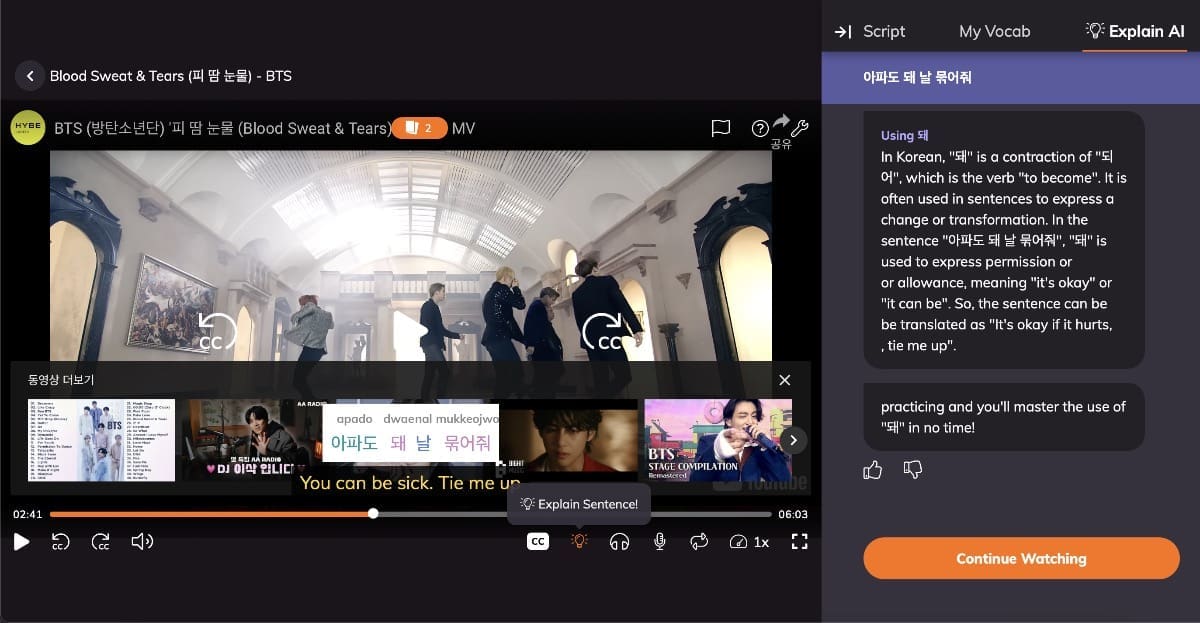
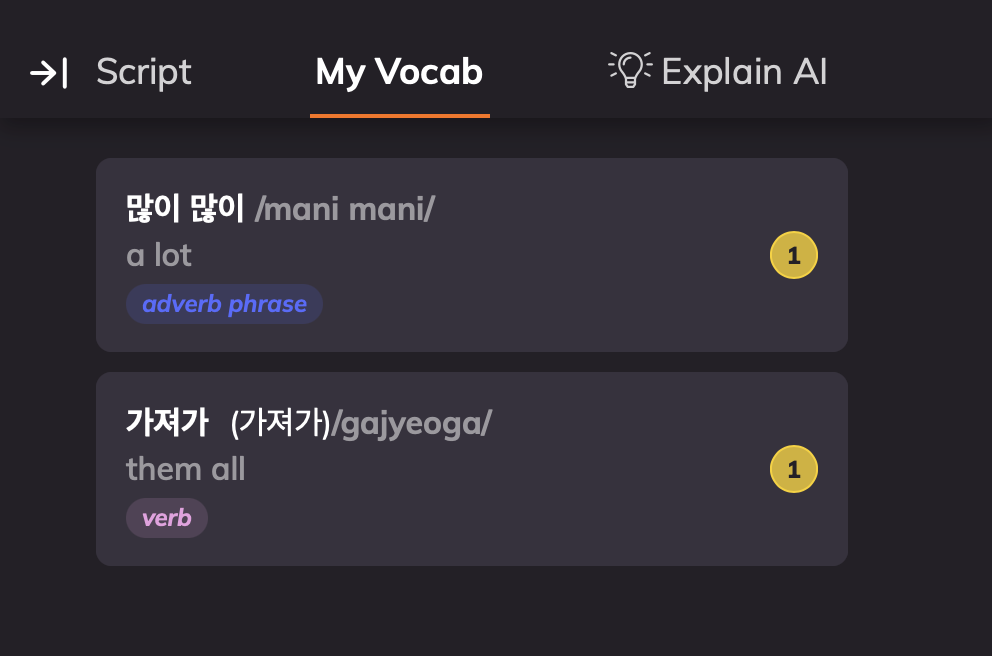


You can also use this feature by selecting the light bulb beneath the video (not seen here but is shown on Netflix). Captions in English and Korean were also available to me, in addition to the option to loop a sentence and change the speed.
Once a video is playing, you can click on a word in the interactive subtitles, get a definition, have it repeated, and add it to your vocab list.
Once it’s on your vocab list, you can return to the word at any time and have the video replay that particular section, its ‘Last Occurance.’
You can also practice with ‘Say It,’ which allows you to record your voice saying the selected phrase, and then Lingopie will grade you on how well you’ve done. I found this option available on music videos but not on Netflix.
Learning with Lingopie


Once you’ve selected a group of words you’d like to focus on, you can use Lingopie’s other features by visiting the ‘Practice’ page. Here you’ll find a list of all your Vocab words you’ve amassed as well as where they’ve come from.
You’ll also find ‘Sentence Wizard,’ ‘Flash Cards,’ ‘Pop Quiz,’ and ‘Word Master.’
Sentence Wizard: Listen to an audio clip and then rearrange the words to match the sentence.
Flash Cards: Listen to an audio clip and then see if you can recall the meaning of the word. You can also see the word below.
Pop Quiz: Listen to an audio clip and then select the correct the meaning of the word from a list of options. You can also see the word below.
Word Master: Match three words with their English meanings on the right.
In addition to these tools, you can also join their Discord channel or do live group lessons. They cost extra, but the 1st lesson is free. Private lessons are available as well.
The Lingopie Library

The last page you have access to is the ‘Library.’ It shows what media you’ve already started, making it easy to return and pick up where you left off. It also stores any tutorial videos you’ve watched so if you forget anything you can come back here.
Key Features for Travelers

Now that you know how Lingopie works, here are the key features I believe are helpful or not so much for travelers. Essentially, my pros and cons list of using Lingopie for language learning for travel purposes.
Pros for Travel-Oriented Learning
- I find immersive learning through entertainment to be a fun way to learn a language as you’re also watching and taking in the culture and, very likely, destinations in the home country of the language. Before I travel anywhere, I usually try to find a movie or TV show filmed there so that I can get an idea of what I’m in for, so using Lingopie facilitates this.
- As you’re listening to a show or film, learning with Lingopie focuses on natural, real-world conversational language instead of ‘see spot run’ type of sentences.
- The platform offers a variety of content for different skill levels.
- As you’re watching shows with authentic accents and regional variations, it’ll give a better listening experience than an automated voice repeating a sentence to you.
- The speed options are wonderful to slow down the content so a beginner can have more time to comprehend.
- The platform’s ‘Explain AI’ or ‘Grammar’ section allows for cultural context, helping to give context around a word or sentence that may not be obvious to the language learner.
- The ‘Say It’ feature is a fun way to practice speaking.
- ‘Loop Sentence’ is a nice way to gain clarification.
Cons and Limitations
- While Lingopie has many options, they only have content for specific languages, so if you’re not interested in one of the languages they provide, then Lingopie won’t be helpful to you.
- To access Lingopie, you have to be connected to the internet.
- Lingopie is a paid program.
- Their ‘Speak Sentence’ feature is far too fast for beginners.
- Their ‘Auto-pause’ feature is nice in that it’ll stop the content at the end of each subtitle, however I feel that kind of defeats the purpose of watching something in the first place.
- The ‘Pop Quiz’ will replay the video portion that has that word, helping to recall its context. However, this only works for music videos to my knowledge as any words I had saved from Netflix didn’t come with playback. I assume this is due to copyright on Netflix’s end.
- You have to be speedy about clicking words or hit the back button if you miss one you want to study which to me was distracting me from enjoying the content.
- While Netflix and Disney+ are available on Lingopie, not all their content is available on the platform. It appears that mostly popular shows and movies are the ones listed.
How to Maximize Lingopie for Travel
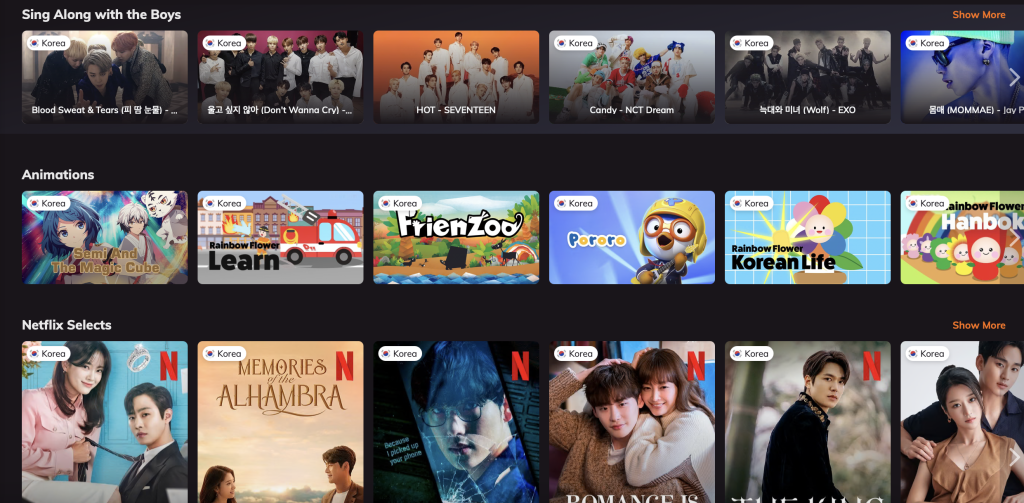
To use Lingopie for travel, I suggest that it is best to choose a series or movie you can learn from. By that, I mean watching Star Wars, for example, likely wouldn’t help as it’ll have a lot of phrases you won’t likely need on vacation.
When I was watching Kdramas during quarantine, I realized I mostly picked up words that were frequently repeated. For instance, I watched a show with a doctor in it, and since they kept addressing him as the doctor, I easily found myself recalling that word, 의사 (uisa).
Or if you find it challenging to pick based on possible vocab, choose based on interest. You don’t want to spend hours watching something, even if it has good vocab if you find it boring. The first Kdrama I watched was actually by mistake.
I picked it because, at the time, in early 2020, I was supposedly going to Spain and Portugal soon, so I looked on Netflix for a series filmed there. What I found was a series called Memories of the Alhambra that was shot in Granada, Spain.
I quickly fell in love with the series, so much so that I didn’t mind the subtitles. It also wound up inspiring me to visit the Alhambra.
Aside from selecting content relevant to your destination, what you can also do to travel prep is create a schedule for yourself so that you practice as much as you can before your trip.
I would also highly suggest you combine Lingopie with other learning methods, especially if you are a beginner.
Cost and Value for Travelers
Lingopie’s subscription options are as follows (as of the publish date):
- $12/month for 3 months ($36 total) for one language
- $5.99/month for a yearly plan ($71.88 total) for all languages offered
- $199 for a lifetime subscription for all languages offered
All subscriptions offer a 7-day free trial and may be canceled at any time.
In comparison to other popular language learning platforms…
Duolingo: Offers a free plan and paid ones at $12.99/mo, $59.99/year
Babbel: $13.45/mo for 6 months, $8.95/mo for 12 months, and $299 for lifetime
Rosetta Stone: $19.95/mo for 3 months for a single language, $19.95/mo for 12 months for a single language, and $399 for a lifetime and access to all languages
Pimsleur: $19.95/mo for French only, $20.95/mo for all languages, and $164.95 for 12 months for all languages
Alternative Options
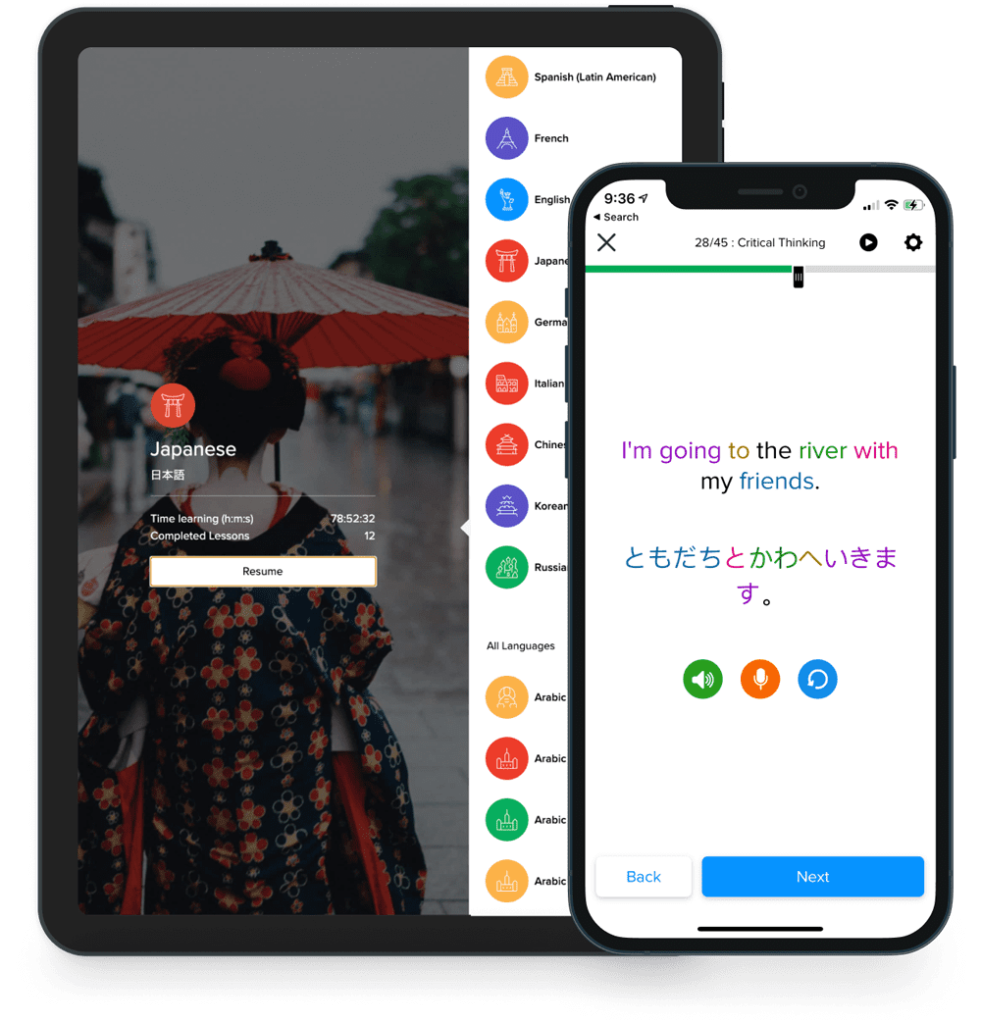
In addition to the popular competitors I’ve listed above, I’ll recommend some complementary tools and a Lingopie alternative for travelers.
Mango Langages
Mango Languages is similar to Duolingo in that it’s an app-based language-learning tool. What I liked about Mango over Duolingo is that I never felt like I learned anything from Duolingo. I’ve also heard the same from many friends who have used it.
It gamifies the system quite a bit, which is great to get you hooked, but it doesn’t provide much actual assistance in learning phrases easily used while traveling.
Conversely, Mango helped me learn some basic German phrases I used on my trip to Austria and Germany.
And equally important, it’s free as I have a library card! Now, not all libraries will provide free language learning tools like this, but it’s worth inquiring about. If they don’t have Mango, they may have another option available to you.
90 Day Korean

The other tool I’ll recommend is finding a course specifically tuned to the language you’d like to learn, for instance, 90 Day Korean.
I signed up for this course during quarantine and found the way they taught to be very comprehensive. It took me to the basics of the language, which gave me building blocks so I could easily construct sentences on my own rather quickly.
However, if you’re only visiting a destination for a week, this may be overkill for travelers as this kind of learning is more for those who really wish to understand the language rather than just picking up a few phrases.
The Viki App

Lastly, the Lingopie alternative for travelers I’d most recommend is an entertainment app focused on your target language. I subscribe to Viki, which boasts a lot of East Asian content from South Korea, Japan, China, and more.
What’s great about this app is that the subtitles also provide cultural context. What do I mean by that, for instance, ‘nose bleed’ in Korean is 코피 (kopi), which sounds the same as the word for ‘coffee’ 커피 (keopi).
I know this because a show I watched on the platform told me. In the scene, the characters get confused. They kept telling their boss he had a nosebleed, and he thought they were asking if he wanted coffee.
As a non-native Korean speaker, I would not have gotten this without the cultural context provided by Viki’s subtitles, which are written primarily by fans, which makes it an especially fun experience. I could give tons of other instances such as Korean slang that doesn’t easily translate without context, but you get the idea.
Viki also has a learn mode that similar to Lingopie.
Final Thoughts on Lingopie
While I believe that Lingopie is a wonderful listening comprehension tool that’ll help immerse learners into the culture and more realistic conversation, I do not believe it is the perfect tool for travelers.
It would be too difficult for beginners to pick up as you have to individually click each word you wish to focus on which to me takes away from watching a piece of content.
It also isn’t really feasible for those only visiting a destination for a few days who only wish to pick up key phrases as finding those key phrases within the content will be challenging.
But is Lingopie worth it beyond that? If you wish to dive into a language and enjoy watching a TV show or movie in the language you’d like to learn, then I say yes, Lingopie is worth it for this instance. It’ll allow you to hear native speakers, gain some insight into their accents, and help you listen and speak overall with the assistance of their tools.
Transparency: I was provided a free 2-week trial to test out Lingopie. However, all thoughts and opinions expressed are my own.
Lingopie FAQs

How Much Does Lingopie Cost?
Lingopie costs $12/month for one language for 3 months ($36 total). $5.99/month for a yearly plan ($71.88 total) for all languages offered and $199 for a lifetime subscription including all languages offered.
Is Lingopie Better than Duolingo?
Lingopie and Duolingo are two very different platforms. Lingopie helps meld entertainment media with language learning, helping users to learn while they watch. Conversely, Duolingo is more about gamifying the language learning process.
Can You Become Fluent with Lingopie?
I do not believe you can become fluent solely with Lingopie. I see it as more of a companion tool on a language-learning journey.
Is Lingopie Good for Complete Beginners?
I do not believe Lingopie is good for complete beginners, as you’ll essentially need to add a lot of words to your vocabulary then, which will take a lot of time. Some of the tools will also be difficult to use, such as ‘Sentence Wizard,’ if you have no prior knowledge. Lingopie is best used in conjunction with other language-learning tools so that you can work on listening comprehension.
Related Travel Tech & Apps Guides
- The Best Apps for Traveling in Europe that are FREE
- 27 of the Best Travel Apps for Paris That are FREE
- Bumble BFF Review: How I Easily Met My Travel Buddy
- Review of Mango Languages: Free Way to Learn a Language
- Is Lingopie Useful to Travelers? My Honest Review
- How to Use the Google Translate App for Communicating Abroad
- What’s the Best Camera for Solo Travel? Honest Review of the Insta360 GO Ultra
Want to remember this? Pin this Is Lingopie Useful to Travelers Wanting to Learn a Language? article to your favorite Pinterest board!

