

Visitor’s Guide to Hellbrunn Palace: Trick Fountains & The Sound of Music
This site contains affiliate links and is a member of the Amazon Associates Program. At no additional cost to you, I may receive a commission from these links. I only make recommendations based on my experience. See my Disclosure Policy for more info.

Curious about Hellbrunn Palace’s famous “trick fountains” and that iconic Sound of Music gazebo when there’s so much to do in Salzburg?
Having experienced the delightful chaos of Hellbrunn Wasserspiele (aka Water Games) firsthand with my mother—watching children squeal with joy as water shot up through stone seats while adults scrambled to stay dry—I can tell you that this Salzburg Palace is unlike any other European castle I’ve ever visited before.
Whether you’re a Sound of Music fan hunting for filming locations, a family seeking interactive entertainment that will captivate kids and adults alike, or simply someone who wants to see a water-powered organ with 138 moving figures still operating after 270 years, this whimsical palace offers something unique.
In this guide, I’ll walk you through how to navigate public transport from central Salzburg, what to expect, and how to avoid the water tricks, so you can plan the perfect visit to this 400-year-old pleasure palace without getting drenched!
What is the History of Hellbrunn Palace?
Constructed between 1613 and 1619 by Markus Sittikus von Hohenems, the Prince-Archbishop of Salzburg, the Palace takes its name from the German for “clear spring,” which provides the Palace with its source for the wondrous trick fountains (Hellbrunn Wasserspiele).
Solely used as a day residence in summer, it was a respite and oasis of pleasure for the Archbishop Markus Sittikus and his confidants away from the city.
In fact, there are no bedrooms at Hellbrunn Palace at all!
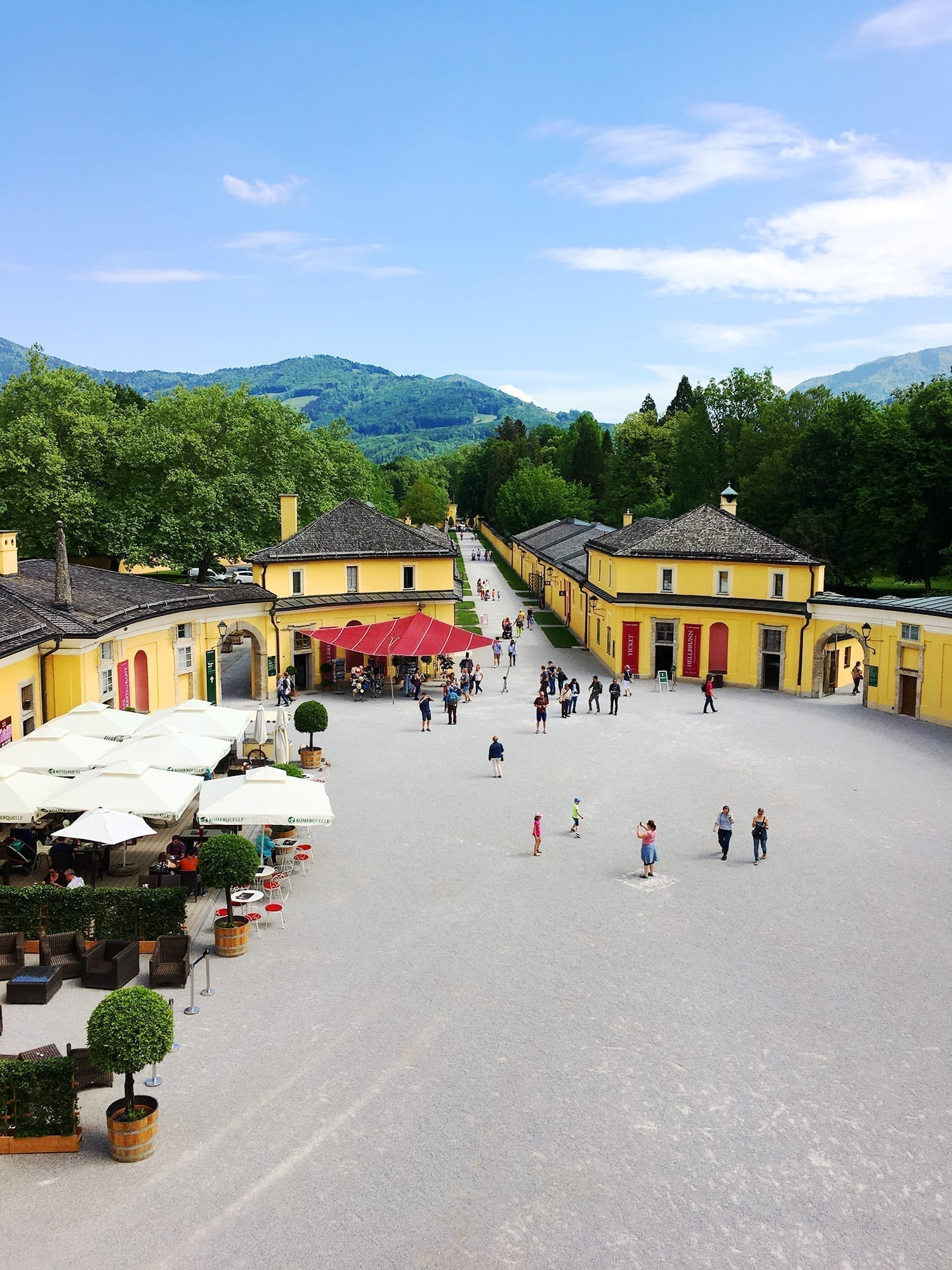
Before your mind wanders into the gutter, the Palace was built for celebration, pleasure, and recuperation.
Owning a pleasure palace was highly fashionable around 1615.
Established as an early Baroque villa, like the Baroque Austrian National Library in Vienna, this marvelous palace is located near Morzg, a southern district in Salzburg, Austria.
The Water Games (Hellbrunn Wasserspiele)
Since the Prince-Archbishop had an incredible sense of humor, he designed elaborate practical jokes to surprise and delight his visitors, which still work today.
Providing not only a beautiful place to spend the day away from Salzburg, but also a place to be entertained.
Think 17th-century home water park.
His Salzburg Water Games (or, in German, Salzburger Wasserspiele) refers to the trick fountains that Schloss Hellbrunn is so famous for!
Spending time here leaves you feeling elated as adults and children alike run through the waterworks, like kids running through sprinklers on a hot summer day.
It was lovely to see how much joy the Hellbrunn Wasserspiele gave everyone!
Touring the Trick Fountains
When I visited in 2018, they offered guided tours.
However, it appears that it’s no longer on offer, according to their official website, which now only lists audioguides.
Still, since it’s a 400-year-old Palace, the trick fountains are the same; you’ll just have to be more aware of where to stand to avoid getting splashed, as my former trick was to stick next to the tour guide, as she/he stays primarily dry.
It’s also where the Archbishop stood or sat to watch his friends enjoy Hellbrunn Wasserspiele.
The Trick Table
The first trick fountain on the 40-minute tour appeared as a stone table with surrounding seats.
Our guide asked for volunteers; some eager children stepped up and sat around the table.
The lovely tour guide, who provided the tour in English and German, distracted them long enough to surprise them with water that shot up through the seats!

The Mechanical Theater
But it’s not all gag seats on this tour; there’s also a water-powered mechanical theater accompanied by a 1750 organ that still works!
It is the youngest part of the trick fountains and includes about 138 moving figures.
Both the figures and the organ are powered by water pressure.
They depict the life of a small Baroque city to the tune of “Give Me Your Hand, My Darling,” an opera song.
The Grottoes
On the tour, there are several grottos adorned with shells from floor to ceiling, representing Greek mythology and its honored Gods.
One of the grottos even sings!
The Midas Grotto, or Crown Grotto, propels a crown to float atop a water jet, symbolizing the rise and fall of power (see the YouTube short above).


I was truly awed by the time it must have taken to decorate these grottoes, as they are covered in shells!
Between these and the trick fountains, this Palace was my favorite thing I saw in Salzburg!
The Statues and Artistry
Some of these are trick fountains, but aside from that feature, I really enjoyed simply seeing all the statues and artwork around the Palace.


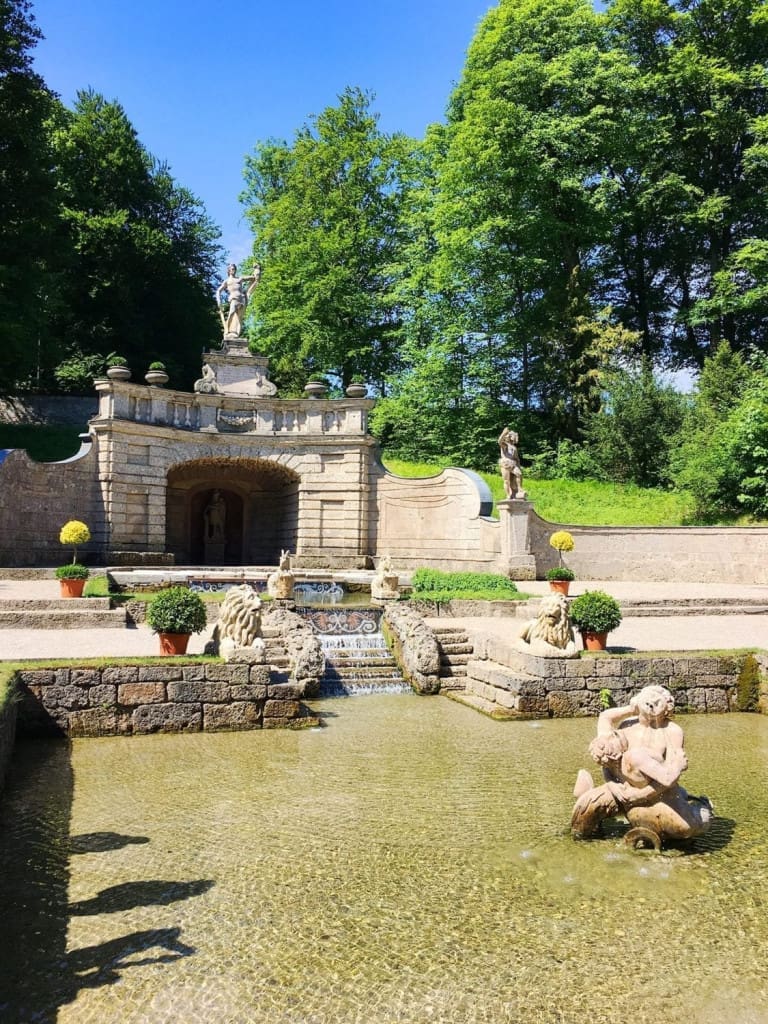
You can spot everyone from Poseidon (the ancient Greek god of the sea) to a woman and her dog.
I could have spent a good chunk of time here just examining these!
However, if you’re not as keen on art, just keep an eye out for them while experiencing the trick fountains, as you’ll certainly see plenty that way.
Hellbrunn Palace Park & the Gazebo
Hellbrunn Palace is situated in a large park (Schloss Hellbrunn Parken), which includes a nearby zoo, a stone theater, and a small building known as the Monatschlössl, or the “little month-palace.”
Built in one month after a visitor commented to the Prince-Archbishop that a building on the hill would improve the view from one of Hellbrunn’s windows.


You may recall that famous “Sixteen Going on Seventeen” song from The Sound of Music?
The gazebo where Liesl and Franz first meet is in the Hellbrunn Palace Park.

Originally, it was located at Leopoldskron Palace, but it was moved here to be more accessible.
Though my mom and I are fans of this film shot in Europe, we didn’t visit as it’s further into the park than she wanted to walk.
Note, the inside is typically closed, so don’t expect to recreate the famous scene.
However, there are plenty of Sound of Music filming locations you can visit in Salzburg!
The Palace Exhibition
Why you should visit Hellbrunn Palace isn’t just for the fountains, but also the interior of the Palace, as it’s just as beautiful as the exterior.
While kids will more likely adore the outdoor entertainment, those interested in how the Palace functions shouldn’t miss this, as inside, they shine a light on the inner workings of the trick fountains.
Take a look at the wooden pipes that used to run throughout the complex to facilitate the fountains. See a behind-the-scenes look at the mechanics that power some of the moving parts.


There are also muraled walls and ornately painted ceilings.
And some fascinating taxidermy!
Though the fascinating bit may be more about my whimsical mood, which inspired that pose, haha!
The permanent exhibition is called “SchauLust,” and it guides you through Salzburg’s Baroque history, the world of Markus Sittikus, and what the city was like in the early 1600s.
The interior isn’t huge, so don’t worry about this taking up a large chunk of your time, but because it is gorgeous, I highly recommend visiting for at least 15-30 minutes.


When is the Best Time to Visit Hellbrunn Palace?
The gardens are open all year, but the Palace and trick fountains only run in the warmer months, from the end of March until the beginning of November.
Typically from 9:30 am to 5:30 pm, with longer hours in peak summer.
During winter, only the gardens stay open.
Be sure to check their official site for dates and times, as they are subject to change.
How Much Does Hellbrunn Palace Cost?
You can only book tickets directly (€16.50 for adults, €9.50 for students 19-26, and €6.50 for kids) or visit with the Salzburg Card.
**Prices last verified April 2026
I used the Salzburg Card to get into Hellbrunn Palace and found it super affordable, especially since it covered most of what I wanted to do on my Salzburg itinerary and included public transport.
The tickets include an audio guide tour of the Palace Exhibition and Trick Fountains, and a visit to the Folk Museum.
The latter of which my mom and I skipped, as she was getting tired and it would have required more walking.
Alternatively, you can simply tour the gardens, which are free.
I visited in May and didn’t see a massive line, but I’m told summer can get busy, so it’s best to book ahead if you plan on touring the Palace in peak season.
Trick fountains:
Duration of the audioguide: 50 minutes
Palace Exhibition:
Duration of the audioguide: approx. 30 minutes
Folk Museum:
10 minutes on foot from the Palace
Duration of visit: approx. 1 hour
How to Get to Hellbrunn Palace from Salzburg
Hellbrunn Palace is only 3.4 miles (5.5 km) from Salzburg city center.
The easiest and cheapest way to get here is to take Line 25 from the main train station to Hellbrunn (via the city center).
I had the Salzburg Card, which gave me free use of public transportation (except S-railways / S-Bahn), so I took Bus 6 from our hotel to the city center, then got off there, changed buses, and continued to the Palace.
The bus stop is super close to the entrance, so it’s just a short walk.
The whole trip to get there took about 45 minutes from our hotel.
This will obviously differ depending on where you’re staying in Salzburg.
Alternatively, you can travel by bike, boat, or car. Though I wouldn’t recommend the latter if you’re trying to save money, as I took one rather costly ride and regretted it.
As for the boat option, you can get a combo ticket for transport and entrance. I didn’t visit this way, but the short cruise I took as part of the Salzburg Card was lovely so I imagine this would be as well.
🗺️ Download an offline map in advance so you’ll still have a handy guide even if you can’t use your data while abroad. It’s how I easily figured out public transportation in Salzburg!
FAQs
Is Hellbrunn Palace worth visiting?
Yes, Hellbrunn Palace is one of the most unique palaces in Europe and absolutely worth visiting on a Salzburg itinerary.
Unlike traditional castles focused on formal state rooms and portraits, Hellbrunn was built purely for entertainment—a 17th-century pleasure palace with no bedrooms, designed for Archbishop Markus Sittikus to host and playfully drench his guests.
The trick fountains (Wasserspiele) operate exactly as they did when first built between 1613 and 1619, and the Mechanical Theater—a water-powered organ with approximately 138 moving figures, installed in 1750 and still fully functioning—is genuinely remarkable.
The experience works for kids and adults equally: it’s interactive, surprising, and unlike anything else in Austria.
At €16.50 for adults (prices verified April 2026), or free with the Salzburg Card, it offers great value for roughly two hours of unique entertainment.
Was the Sound of Music filmed at Hellbrunn Palace?
The Sound of Music gazebo—featured in the “Sixteen Going on Seventeen” number where Liesl and Franz confess their love, and later in the romantic scene between Maria and Georg—is now located in the gardens of Hellbrunn Palace, but it was not filmed there originally.
The gazebo was originally situated at Schloss Leopoldskron, the lakeside palace that served as the exterior of the von Trapp family home in the film.
After the film’s release, the gazebo was relocated to Hellbrunn Palace to make it more accessible to visitors, as Leopoldskron is private property.
The interior of the gazebo is typically closed to the public, so you can photograph it from outside but cannot step inside to recreate the famous scene.
For a comprehensive guide to all Salzburg filming locations, including Mirabell Gardens, the Felsenreitschule, and Nonnberg Abbey, check my full Sound of Music filming locations guide.
Is Hellbrunn Palace free with the Salzburg Card?
Yes, Hellbrunn Palace is included in the Salzburg Card, which covers free entry to the trick fountains, Palace Exhibition, and Folk Museum, along with free use of Salzburg’s public transportation network (excluding S-Bahn / S-railways).
Without the card, adult tickets cost €16.50, student tickets (ages 19–26) are €9.50, and children’s tickets are €6.50 (prices verified April 2026).
All tickets include an audio guide for the trick fountains and Palace Exhibition.
The Salzburg Card also covers entry to the Hohensalzburg Fortress, Residenz Palace, Mozart’s Birthplace, and over 30 additional attractions across the city, making it highly cost-effective for visitors with a full Salzburg itinerary.
The card is available in 24-hour, 48-hour, and 72-hour versions.
Getting to Hellbrunn by Bus Line 25 from the main train station is also covered under the card, keeping the entire visit cost-free.
How long should you spend at Hellbrunn Palace?
Plan for at least two hours at Hellbrunn Palace to cover the trick fountain audio guide tour (approximately 50 minutes), the Palace Exhibition interior (approximately 30 minutes), and time to wander the gardens.
Add another hour to an hour and a half if you plan to visit the Folk Museum, which is approximately a 10-minute walk from the main palace and takes about an hour on its own.
The Sound of Music gazebo is located further into the park and requires additional walking—factor in extra time if that’s a priority.
Because Hellbrunn is not a full-day attraction even at its most thorough, it pairs well with another Salzburg site on the same day. The Hohensalzburg Fortress is the natural pairing as it’s the city’s largest attraction and easy to reach by bus or tram from the city center.
What is Hellbrunn Palace famous for?
Hellbrunn Palace in Salzburg, Austria, is famous for two things: its 17th-century trick fountains (Hellbrunn Wasserspiele) and the iconic gazebo from The Sound of Music.
The trick fountains were designed by Prince-Archbishop Markus Sittikus von Hohenems when the palace was built between 1613 and 1619, using the natural spring water source that gives the palace its name—”Hellbrunn” means “clear spring” in German.
Hidden jets shoot water through stone seats, into grottos, and past mechanical figures, surprising visitors exactly as they did 400 years ago.
The centerpiece of the fountain tour is the Mechanical Theater: a water-powered organ installed in 1750 featuring approximately 138 moving figures that still operates today.
The Sound of Music gazebo, where the “Sixteen Going on Seventeen” scene was filmed, was relocated from Leopoldskron Palace to Hellbrunn’s gardens to make it accessible to visitors.
Related Salzburg Travel Guides
- Two Days in Salzburg: A Complete Itinerary for First-Timers
- Visit Hohensalzburg Fortress, Salzburg’s 900-Year Old Castle
- Visiting Hellbrunn Palace and its Unique Musical Trick Fountains
- Helpful Guide to “Is the Salzburg Card Worth It?”
- Is Salzburg Worth Visiting? 14 Pros and Cons to Help You Decide
- How Many Days in Salzburg? A Simple Guide for First-timers
- 13 Sound of Music Salzburg Filming Locations + How to Visit
- 32 Things to Do in Salzburg: Top Budget-Friendly Walkable Sites
- Where to Stay in Salzburg Austria: My Favorite Area for First Timers on a Budget
Want to remember this? Pin this Guide to Hellbrunn Palace and its Unique Musical Trick Fountains article to your favorite Pinterest board!

