

What to Eat in Vienna, Austria: A First-Timer’s Guide to Viennese Food
This site contains affiliate links and is a member of the Amazon Associates Program. At no additional cost to you, I may receive a commission from these links. I only make recommendations based on my experience. See my Disclosure Policy for more info.
See more Travel HerStory in Google
Add me as a preferred source in Top Stories and AI Mode.


One of the few things my mother remembers from her childhood is watching her grandmother stretch dough for apple strudel across a massive table.
So when I surprised my mom with a heritage trip in May 2018, deciding what to eat in Vienna was partly about tracing our roots and savoring the dishes as our ancestors would have.
Our family originally lived outside Ljubljana, Slovenia (which we also visited), before moving to Vienna, Austria, and later emigrating to the USA.
If you’re visiting for the first time and wondering what food to eat in Vienna, I’ll share the famous dishes we enjoyed and the ones we didn’t.
From my mom’s disappointment with the Original Sacher-Torte to my emotional reaction to the apple strudel show at Schönbrunn Palace, I’ll offer honest advice to help you spend your limited meals on what’s truly worth it.
What to Eat in Vienna as a First-Timer?
Start with Vienna’s big three: Wiener schnitzel, Sachertorte, and apple strudel, then work in hearty tavern dishes like goulash or roasted pork knuckle. Together they show both sides of Viennese food: elegant coffee house desserts and filling beer-garden plates. When I visited with my mom in May 2018, the fresh apple strudel at Schönbrunn’s Strudel Show beat the famous Sachertorte at Café Sacher. This guide is for first-time visitors who want to try traditional Viennese food.
Traditional Viennese Foods to Try
Wiener Schnitzel
Wiener schnitzel is Vienna’s signature dish: a thin veal cutlet that’s breaded, pan-fried, and served with lemon and potato salad.
In Austria, only the veal version can be called Wiener Schnitzel.
If the cutlet is made from pork, chicken, or turkey, menus must label it as Schnitzel Wiener Art (Viennese-style) or specify the meat (such as Wiener Schnitzel vom Schwein).

I had my first Wiener schnitzel at Schweizerhaus in the Prater, a popular beer garden over 100 years old. The schnitzel was tasty, and being outside in May with lovely weather made for a picture-perfect experience.
A note on Wiener schnitzel: During the latter half of our trip, we had Wiener schnitzel at another restaurant near our Vienna hotel. My mom said hers was very salty. On the flight home, her legs started to swell. She felt unwell, and we suspect the salt played a part.
So if you have health issues, when deciding what to eat in Vienna, ask about the salt content or choose a less salty option.
Roasted Pork Knuckle (Stelze)
Roasted pork knuckle is one of Schweizerhaus’s signature dishes, served with crackling skin alongside freshly grated horseradish and mustard, and fresh white marinated cabbage salad.
I ate a version of this in Munich’s Old Town at the Hofbräuhaus am Platzl, and while the pork was good, I LOVED the dumplings — a yellow potato knödel and a bread dumpling.
So while the cabbage I’m sure is tasty, I’d get their bread dumplings or potato fritters instead.

Sachertorte
Sachertorte is Vienna’s most famous dessert: a dense chocolate cake with apricot jam under a chocolate glaze.
According to the official Sacher website, Franz Sacher created it in 1832 for Prince von Metternich.
My mom and I ordered a slice with coffee at Café Sacher, and she found it drier than the chocolate cakes we’d had before. She even asked the wait staff if it was supposed to be like that.
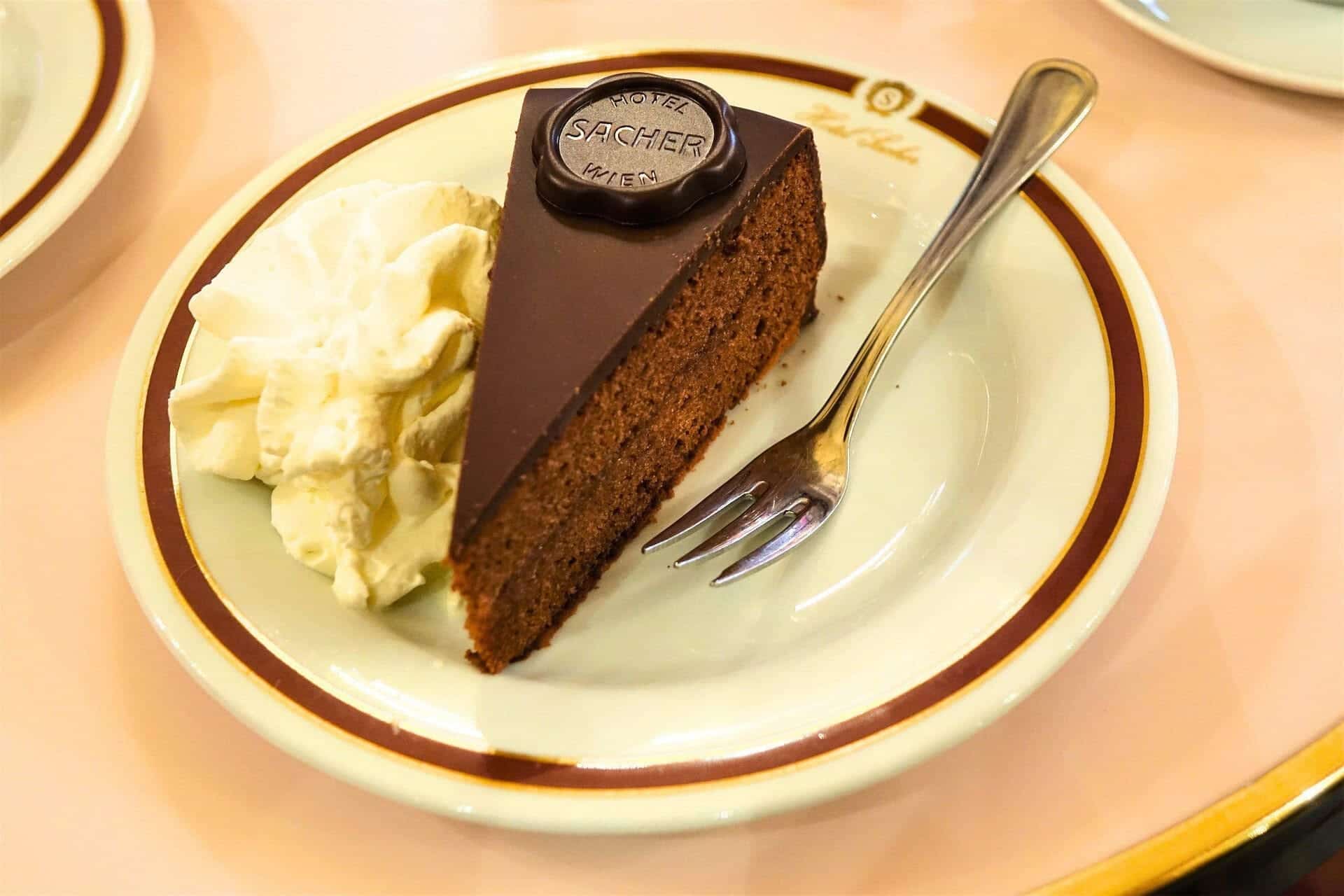
I went for the experience, since so many famous faces have passed through the café, but the cake itself didn’t win us over.
I even chatted with a friend who’s lived in Vienna for a while; she confirmed it’s not meant to be the gooey, moist cake we typically think of.
My advice: When deciding what to eat in Vienna, skip Café Sacher, as there are many other coffee houses that offer cheaper coffee and cake.
Apple Strudel (Apfelstrudel)
Apple strudel is a flaky pastry rolled around spiced apples, and it was the dessert my mom most wanted to try, since her grandmother used to make it.
At the Strudel Show (Gerstner K. u. K. Hofzuckerbäcker Show) inside Schönbrunn Palace, bakers walk you through the recipe step by step, hand-stretching the dough to show you how it’s done.
And don’t worry, the show ends with a warm slice so you’re not sat there just smelling the goodness!
I adored this experience, since I never met my great-grandmother, I felt like this was as close as I’d get to seeing it made traditionally.
The show was included with our Vienna Pass, which is how I’d book it again, as it also includes admission to the Palace.
No reservation is required to attend; however, if you’re not getting the tourist card or don’t want to tour the Palace, you can book separately.
If you’re on the fence about the Palace, check out my post comparing Hofburg and Schönbrunn.
Café Sacher vs. the Schönbrunn Strudel Show
If you only have room for one famous Viennese dessert, make it the Strudel Show (Gerstner K. u. K. Hofzuckerbäcker Show).
| Café Sacher | Schönbrunn Strudel Show | |
|---|---|---|
| What you get | A slice of Original Sacher-Torte, with coffee if you order it | A live strudel-making demo, a tasting, and a recipe to take home |
| Setting | An ornate, historic coffee house | A café inside Schönbrunn Palace |
| Cost | €10.50 | Included with the Vienna Pass when we visited (or €9.50 separately) |
| Best for | Café history and the famous name | Food lovers and anyone visiting Schönbrunn anyway |
| My verdict | Go for the setting, not the cake | Worth it, and the dessert I’d choose again |
My mom and I found the Sacher-Torte drier than we expected.
The strudel came out warm from the oven after we watched it being made, and since the show was already included with our pass, it cost us nothing extra!
This was truly one of my favorite things to do in Vienna.
Other Viennese Classics
I didn’t try every Viennese classic during my visit to Austria, but these traditional Viennese dishes are worth knowing before you read a menu.
Kaiserschmarrn
Kaiserschmarrn is a thick, fluffy pancake that’s torn into pieces, dusted with powdered sugar, and usually served with plum compote (Zwetschkenröster).
It’s sweet, but Austrians often eat it as a full meal.
Tafelspitz
Tafelspitz is boiled beef simmered in broth and served with apple-horseradish sauce, chive sauce, and roasted potatoes. It’s often linked to Emperor Franz Joseph.
Goulash (Gulasch)
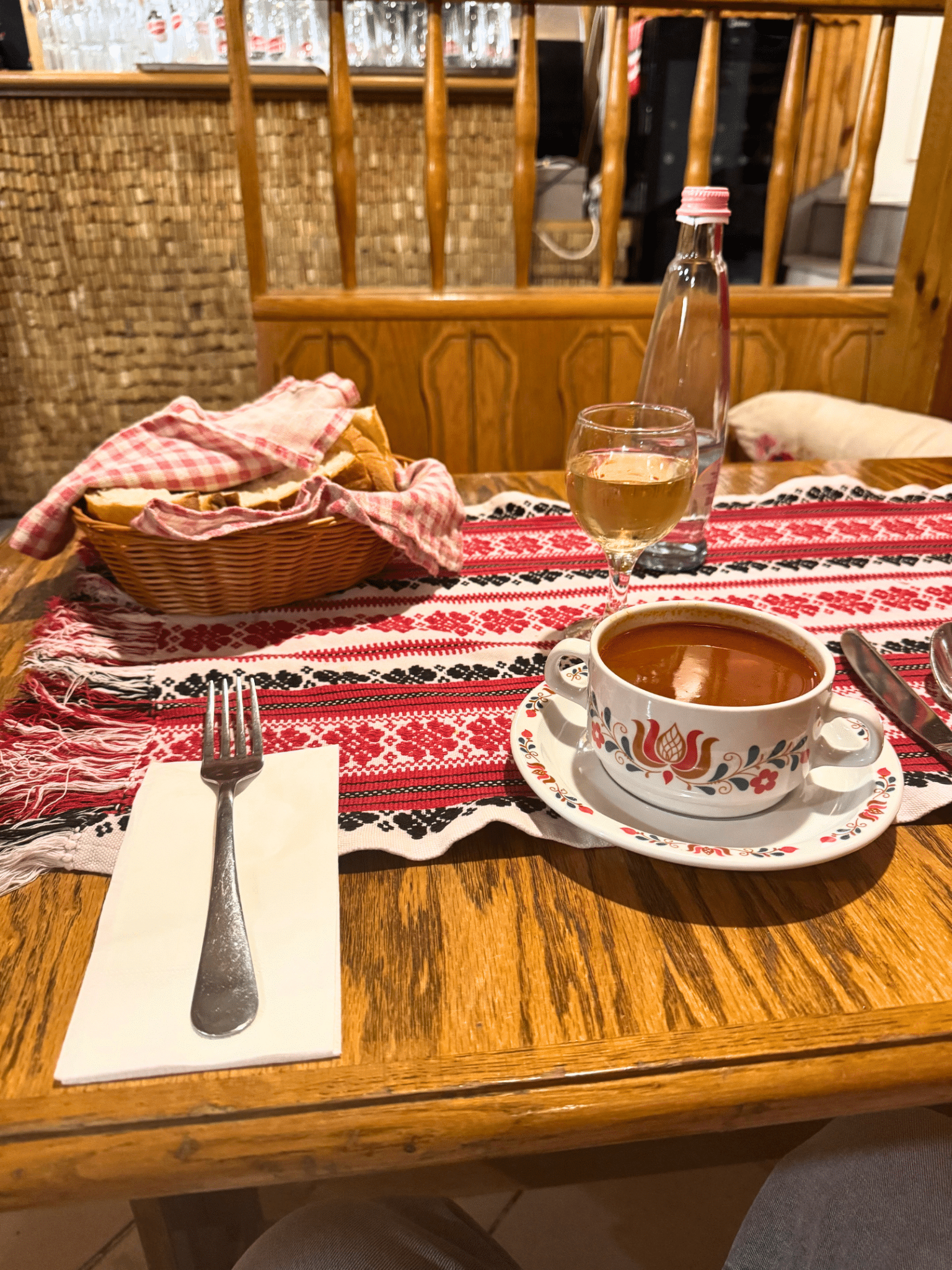
Goulash came to Vienna from Hungary. The Viennese version (Saftgulasch) is a rich beef-and-onion stew, usually served with bread or a dumpling.
I tried goulash in Budapest in 2025 and adored it! It is a hearty, filling dish.
Würstel (Sausage Stands)
Würstelstände are Vienna’s street food stalls. The classic order is a Käsekrainer, a pork sausage filled with cheese, served with mustard and bread.
What to Drink in Vienna
Viennese Coffee
Coffee at a Viennese coffee house usually comes with a glass of water on a small tray.
A Wiener Melange, similar to a cappuccino, is the classic order.
🎬 Film Fan Tip: Café Sperl is the coffee house from Before Sunrise (1995), where Jesse and Céline pretend to call their friends. I didn’t make it there on my trip, but it’s an easy way to pair a Viennese coffee with a filming location.
Heuriger Wine
Heuriger wine is poured at taverns in wine villages like Grinzing, where the wineries serve their own young wine.
According to Wien.info, Vienna is the only city in the world with significant winegrowing within its boundaries, making a trip up to Grinzing special, especially for wine lovers.
My mom’s friend, who lived here when she was young, recommended it, and we hardly saw any tourists when we visited for a glass and a meal.

Radler
Radler is the beer to order if you’re like me and not much of a beer fan.
A radler is a light, refreshing drink made by mixing beer with lemon soda or fruit juice, usually half and half, so it’s not as heavy as a typical beer.

I ordered both a radler and a Budvar in Vienna, and I’d recommend either one to non-beer drinkers.
Where to Eat in Vienna
Schweizerhaus
Schweizerhaus is a beer garden restaurant in the Prater, the park that’s also home to the Wurstelprater amusement park (in case you want to sip a radler while the younger ones entertain themselves nearby).
It’s where I first tasted Viennese food, and its large garden makes it easy to spend a whole afternoon there.

Along with classics like goulash and Wiener schnitzel, it’s known for roasted pork knuckle and potato pancakes.
It also serves Budweiser Budvar on tap with less carbonation than usual. I’m not a beer fan, but I ordered one and would happily order it again.
Just be aware that they are only open from March 15 to October 31 if you plan to visit outside peak or shoulder season.
Grinzing
Grinzing is an old wine village on the edge of Vienna, where local wineries pour their own wine at traditional taverns called Heurigen, often with live music.
For a more low-key, hidden-gem experience, I’d head here.

Spittelberg
Spittelberg is a small quarter near the MuseumsQuartier, lined with cobblestone lanes and featuring Baroque townhouses, cafés, restaurants, and garden bars.
My mom and I wandered through it, and it’s a good look at what 18th-century Vienna was like.
It’s an easy place to stop for lunch or dinner if you’re visiting places like the Sisi Museum or the Austrian National Library.
Around the holidays, Spittelberg hosts one of Vienna’s Christmas markets. Use my How Many Days in Vienna guide to plan out your itinerary, no matter which season you visit.
FAQs
What food is Vienna famous for?
Vienna is famous for Wiener schnitzel, Sachertorte, and apple strudel, along with coffee house culture and hearty tavern dishes like Tafelspitz and roasted pork knuckle.
Many of its best-known dishes date back to the Habsburg court, which is why Viennese menus mix imperial desserts with filling comfort food.
What is Vienna’s signature dish?
Wiener schnitzel is Vienna’s signature dish: a thin veal cutlet that’s breaded, pan-fried until golden, and served with lemon and potato salad.
Only the veal version can be called Wiener Schnitzel in Austria, so the pork version is listed as “Schnitzel Wiener Art.”
How do you say “check please” in Austria?
“Zahlen, bitte” (TSAH-len BIT-teh) is the most common way to ask for the check in Austria, and “Die Rechnung, bitte” also works.
Servers usually won’t bring the bill until you ask, so don’t wait.
When you pay, round up or add about 5–10% and tell your server the total, rather than leaving cash on the table.
I used Mango Languages to learn some German before I visited Vienna. See my Vienna travel guide for more essential phrases.
Related Vienna Travel Guides
- Vienna Travel Guide: Essential Tips for Your First Trip to Austria’s Capital
- Guide to the Hofburg Palace and Sisi Museum in Vienna
- Austrian National Library: Live a Bookworm’s Dream in Vienna
- How Many Days in Vienna? A Simple Guide for First-timers
- How to Spend 2 Days in Vienna: Budget Itinerary + Map
- Is Vienna Worth Visiting? 13 Things to Consider Before Traveling
- Helpful Guide to “Is the Vienna Pass Worth It?”
- Hofburg Palace vs Schonbrunn Palace: Which Imperial Experience is Better?
- 37 Things to Do in Vienna: Exploring Austria’s Capital Affordably
- Where to Stay in Vienna: My Favorite Areas + Best Budget Hotels
- How to Spend 3 Days in Vienna: My Budget-Savvy Itinerary
- What to Eat in Vienna, Austria: A First-Timer’s Guide to Viennese Food
Want to remember this? Pin this What to Eat in Vienna: A First-Timer’s Guide to Viennese Food article to your favorite Pinterest board!

